Part of The Complete Resume Guide for 2026. This post is one chapter in the pillar guide that covers format, ATS, keywords, tailoring, and role-specific examples end-to-end.
You are scared a recruiter will spot AI and throw your application out.
The fear is real. You have seen the headlines about companies using AI detection tools. You have read Reddit threads about people getting rejected for "obviously AI-written" applications. So you are sitting there wondering: can I use ChatGPT to help with my resume, or will it get me blacklisted?
Here is the honest answer: the problem is not using AI. The problem is using it badly.
Quick Answer: Will employers reject my resume if I used AI to write it? Almost certainly not. Most employers don't run dedicated AI-content detectors on resumes — they care about whether your resume matches the job description, not whether AI helped polish the language. The real risk is using AI as a ghostwriter and producing generic, formulaic content; use AI as a collaborator (generate, then edit and personalize) and your resume reads as your own work.
Should You Opt Out of AI Resume Screening?
Short answer: usually no. Here is why.
Most companies that use AI resume screening use it as a first filter to rank candidates, not as a binary accept/reject gate. Opting out (when the option exists) often means your resume goes to a slower manual queue or gets deprioritized entirely.
When opting out makes sense:
- The company explicitly offers a human-only review track with no penalty
- You are applying to a very small company where a human reads everything anyway
- The role is creative and your portfolio matters more than keyword matching
When opting out hurts you:
- Large companies where AI screening is the only realistic path to a human reviewer
- Roles with 500+ applicants where manual review means weeks of delay
- Any situation where opting out flags you as "difficult" before you start
The better strategy: optimize for the AI screen, then impress the human. Use tools like JobVouch's ATS Resume Checker to see exactly how AI systems score your resume and fix gaps before submitting.
Is My Resume Getting Rejected by AI?
If you are applying to 50+ jobs and hearing nothing back, AI screening may be filtering you out. Here are the signs:
- You never hear back at all -- not even a rejection. Your resume may not be reaching humans.
- You are qualified but get instant rejections -- automated systems can reject within hours.
- You are using a creative/multi-column format -- many ATS systems cannot parse these.
- Your resume lacks keywords from the job description -- AI screening matches your resume against the JD.
How to test this: Upload your resume to a free ATS score checker. If your score is below 60%, AI screening is likely filtering you out. Fix the keyword gaps, switch to a single-column format, and reapply.
The "Why": Why the old way fails
- Blind copy-paste creates generic, robotic language. When everyone prompts ChatGPT the same way, everyone sounds the same. Recruiters notice.
- People exaggerate because AI makes it feel distant. When you are not writing the words yourself, it is easier to stretch the truth.
- There is no review step, so errors slip through. AI does not know your real experience. It makes stuff up. If you do not catch it, you are lying on your resume.
- AI-generated text has tells. Certain phrases, structures, and patterns are recognizable. "Leveraged synergies to drive results" is a dead giveaway.
The Fix: Use AI as a collaborator, not a ghostwriter
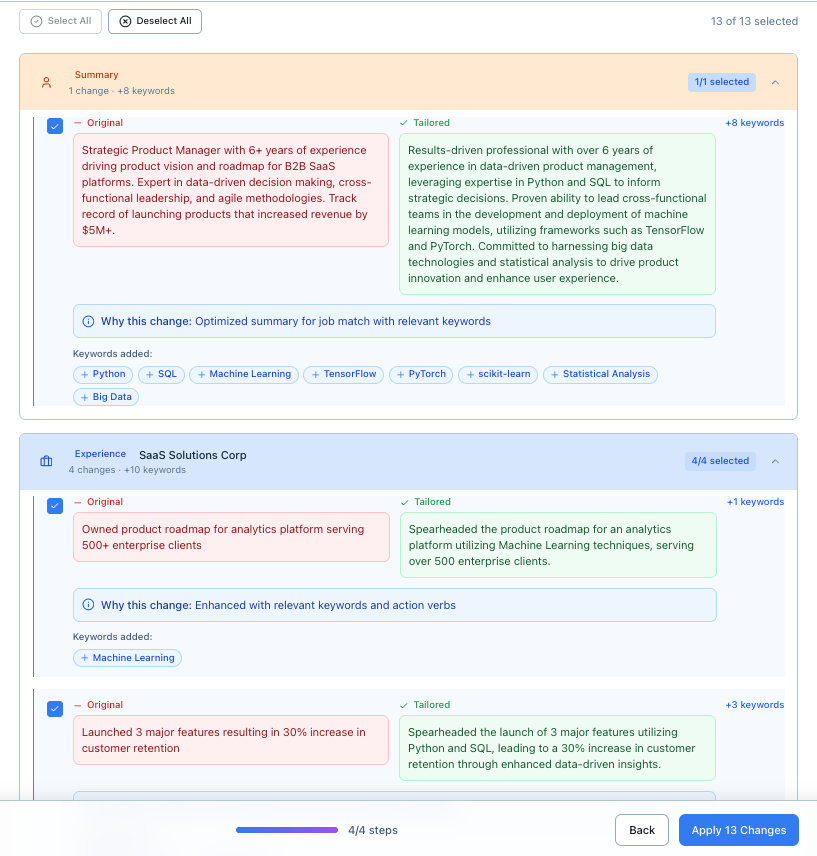
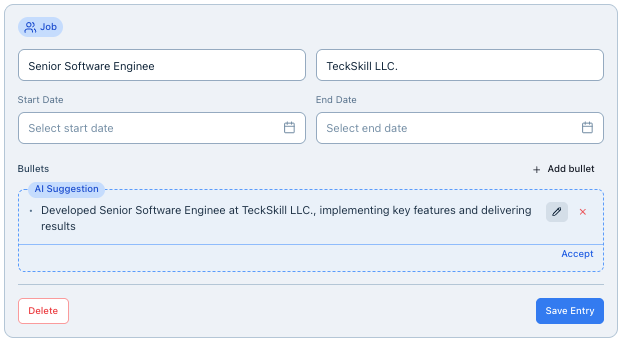
JobVouch is built for ethical resume AI use. It takes your existing bullets, the ones you wrote from your real experience, and suggests improvements. You see every change highlighted. You accept what sounds like you and reject what does not. You stay in control.
What employers actually care about
Let me be direct about this because there is a lot of noise online.
Most employers do not care if you used AI tools. What they care about is:
- Accuracy. Is what you wrote true? Can you back it up in an interview?
- Relevance. Does your experience match what they need?
- Professionalism. Does your resume read well and look clean?
Using AI to polish your language or help structure your bullets is no different from having a friend proofread your resume. Using AI to invent experience you do not have is fraud.
The real risk: what gets people rejected
It is not "using AI." It is:
- Generic language that could apply to anyone. "Results-driven professional with a passion for excellence." Nobody talks like that. It screams template.
- Claims that do not match the interview. If your resume says "Led team of 15" and you struggle to describe basic leadership situations, that is a red flag.
- Obvious ChatGPT patterns. Overuse of certain phrases, overly formal tone, perfect grammar with zero personality.
- Inconsistency. Your resume sounds like a Harvard MBA but your cover letter has typos and your LinkedIn says something different.
How to use AI the right way
Step 1: Start with your real experience
Do not ask AI to write your resume from scratch. Write rough bullets yourself first, even if they are messy. "Did customer support stuff and helped people with problems" is fine as a starting point.
Step 2: Use AI to clarify and quantify
Ask AI to help you:
- Make the bullet more specific
- Add metrics if you provide them
- Improve the structure without changing the meaning
Do not ask AI to:
- Invent numbers or achievements
- Add skills you do not have
- Write sections you cannot explain
Step 3: Edit for your voice
Read every suggestion out loud. Would you actually say this? Does it sound like something you would write? If not, change it until it does. Your resume should sound like a more polished version of you, not like a different person.
Step 4: Keep claims verifiable
For every bullet, ask yourself: if an interviewer asks me about this, can I tell the story? If you cannot, rewrite it or delete it.
Myth vs. fact
| Myth | Fact |
|---|---|
| AI is banned everywhere | Most employers use AI in their own hiring process. They care about accuracy, not tools. |
| Recruiters can always detect AI | Detection tools have high false positive rates. Human editing makes AI-assisted text indistinguishable. |
| Using any AI is cheating | Using AI to improve your writing is the same as using spell check or Grammarly. The content still needs to be true. |
| AI always sounds the same | Raw AI output has patterns. Edited AI output sounds like whoever edited it. |
| You must disclose AI use | Unless specifically asked, you are not required to disclose what tools you used to write your resume. |
Signs your resume sounds too "AI"
Watch out for these patterns that signal unedited AI text:
- Buzzword overload. "Synergize," "leverage," "spearhead," "pioneered" appearing repeatedly.
- Overly formal transitions. "Furthermore," "Moreover," "In addition to the above."
- Vague superlatives. "Exceptional," "outstanding," "world-class" without proof.
- Perfect parallelism. Every bullet has identical structure. Real writing has natural variation.
- Generic claims. "Passionate about driving results" (results for what? what results?).
How to fix it
- Replace buzzwords with plain language. "Led" instead of "spearheaded."
- Cut the transitions. Bullets do not need connective tissue.
- Replace adjectives with evidence. "Increased sales 30%" instead of "exceptional sales performance."
- Vary your sentence structure. Some bullets can be short.
- Add specifics. Company names, tools, numbers, context.
What if a company uses AI detection?
Some companies do run applications through AI detection tools. Here is what you should know:
- Detection tools are unreliable. They have high false positive rates and can flag human-written text as AI.
- Editing defeats detection. The more you personalize and revise, the less detectable AI assistance becomes.
- Most companies do not use detection. They rely on interviews to verify claims instead.
- If asked, be honest. "I used AI tools to help polish my wording, but all the experiences and numbers are my own."
What NOT to do
- Do not copy-paste raw ChatGPT output. Always edit extensively.
- Do not use AI to fabricate experience. This is lying and will catch up to you.
- Do not use AI-generated cover letters without heavy personalization. These are especially obvious.
- Do not assume AI knows your experience. It does not. You must provide accurate information.
- Do not use the same AI-generated summary everyone else is using. If you have seen it before, recruiters have seen it 1,000 times.
FAQ
Q: Should you opt out of AI resume screening? A: In most cases, no. Opting out often means your resume goes to a slower queue or gets deprioritized. The better strategy is to optimize your resume for AI screening using an ATS checker, then let your qualifications speak for themselves.
Q: Is my resume getting rejected by AI? A: If you are applying to many jobs with no responses, AI screening may be filtering you out. Check your ATS score with a free tool. Scores below 60% often get filtered. Fix keyword gaps and formatting issues to pass the screen.
Q: Is using ChatGPT on my resume cheating? A: No more than using spell check or having a friend proofread. The content needs to be accurate. The tool you used to write it is secondary.
Q: Can recruiters really tell if I used AI? A: They can often tell if you used AI badly (generic, buzzword-heavy, or too perfect). Well-edited AI assistance is indistinguishable from good writing.
Q: How do I get my resume past AI screening? A: Use keywords from the job description, stick to a single-column ATS-friendly format, quantify your achievements, and run your resume through an ATS checker before submitting. Tools like JobVouch show you exactly what to fix.
Q: Should I disclose that I used AI? A: Unless the application specifically asks, no. You do not disclose using Grammarly or a thesaurus either.
Q: What if I get called out in an interview? A: If you can discuss everything on your resume confidently and accurately, it does not matter how you wrote it. If you cannot, that is the problem, not the AI.
Q: Is JobVouch different from just using ChatGPT? A: JobVouch is designed specifically for resumes with guardrails. It suggests improvements to your existing content rather than generating from scratch, and it shows you every change so you stay in control.
Related Tools
- Free ATS Resume Checker -- See how AI systems score your resume and fix gaps before applying
- AI Resume Tailor -- Match your resume to any job description without losing your voice
Related Posts
- Is Your Resume Invisible? How to Beat the ATS Robots
- The "Cheat Codes" of Hiring: 50 Keywords Every Resume Needs
- Stop Sending Generic Resumes: How to Tailor in 5 Minutes
Use AI without losing your voice
AI is a tool. Like any tool, it can be used well or poorly. JobVouch helps you use it well: improving your real experience with suggestions you control, so your resume sounds like you, just more polished. Check your ATS score free before your next application.