Part of The Complete Resume Guide for 2026. This post is one chapter in the pillar guide that covers format, ATS, keywords, tailoring, and role-specific examples end-to-end.
You are staring at your resume timeline and the 8-month hole feels like a flashing red warning sign.
If you are searching "resume with employment gap" or "explaining layoff on resume," you already know the anxiety. Here is the truth: gaps are more common than ever. Tech layoffs, caregiving, health issues, career pivots. Recruiters have seen it all. What they have not seen enough of is candidates who own their story with confidence.
Quick Answer: How do you explain a career gap on your resume? List the gap dates honestly, label what you did during that time (caregiving, freelance, study, health, layoff), and frame any skill-relevant work in bullet form just like a job. Don't hide the gap — recruiters always notice missing dates, and obscuring them looks worse than naming them. The candidates who get interviews are the ones who own the gap clearly and tie any productive activity to skills the new role values.
The "Why": Why the old way fails
- Hiding gaps creates suspicion. Recruiters notice missing dates. Trying to obscure them with "2023-2024" instead of months makes it worse.
- Over-explaining wastes space. A paragraph defending your gap takes room from achievements that could get you hired.
- Inconsistent dates confuse ATS. If your formatting breaks, the system might misread your entire timeline.
- Apologetic tone undermines you. Starting with "Unfortunately, I was laid off..." puts you on the back foot before you even interview.
The Fix: Clear dates, clean layout, and skill proof
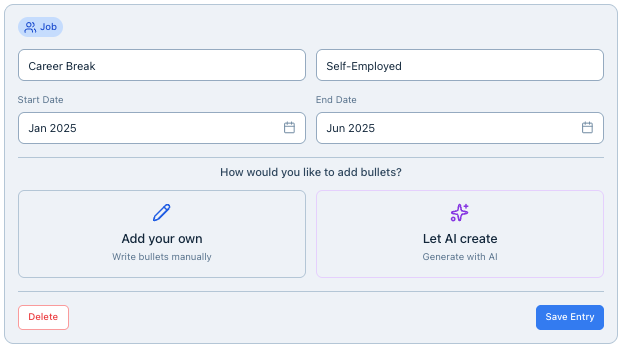
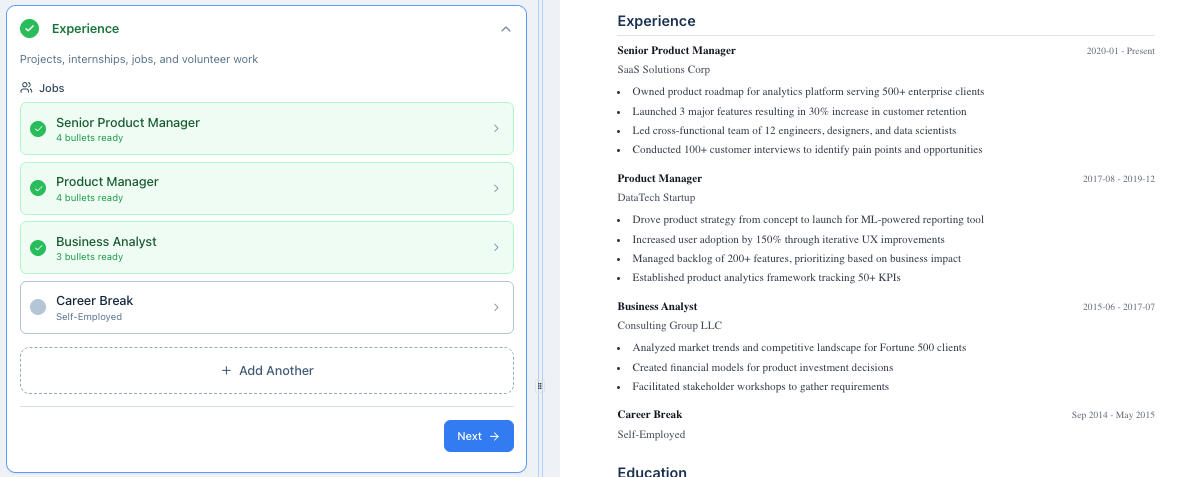
JobVouch formats dates consistently and keeps your layout ATS-friendly, so gaps are readable but not the headline. Use the Skills and Projects sections to show what you did during the break. The goal is not to hide the gap. The goal is to make it a non-issue by showing what you bring now.
Five common gap scenarios (and how to frame each)
1. Layoff or company closure
What happened: Your role was eliminated, the startup folded, or there was a restructure.
How to frame it:
- Do not apologize. Layoffs are business decisions, not performance reviews.
- Use a brief Career Break entry or skip it if you have freelance/contract work to show.
Example bullet:
Career Break (Mar 2024 - Nov 2024) - Company restructure. Used time to complete AWS Solutions Architect certification and contribute to 2 open-source projects.
2. Caregiving (kids, parents, family)
What happened: You stepped away to care for a child, aging parent, or family member.
How to frame it:
- Keep it brief. "Family caregiving" is enough. No need to explain medical details.
- Highlight any skills you maintained or built.
Example bullet:
Family Caregiving (2023 - 2024) - Managed household logistics and coordinated care for family member. Maintained technical skills through online courses in Python and data analysis.
3. Health or medical leave
What happened: You took time to address physical or mental health.
How to frame it:
- You do not owe anyone your diagnosis. "Personal health matter, now resolved" is sufficient.
- Focus forward on your readiness to return.
Example bullet:
Personal Leave (2024) - Addressed health matter, now fully resolved. Returned to professional development with HubSpot Marketing certification.
4. Career pivot or education
What happened: You went back to school, did a bootcamp, or intentionally paused to switch fields.
How to frame it:
- This is the easiest gap to own. Frame it as investment, not absence.
Example bullet:
Career Transition (2024) - Completed General Assembly Data Science Bootcamp. Built 4 portfolio projects applying machine learning to real datasets.
5. Travel, sabbatical, or personal projects
What happened: You took intentional time off for travel, writing, or exploration.
How to frame it:
- Be honest but brief. Show what you learned or built.
Example bullet:
Sabbatical (2024) - Traveled to 6 countries while freelancing as a content strategist. Published 12 articles on Medium with 50K+ reads.
Three ways to present a gap on your resume (pick one)
-
Career Break entry with dates and 1-2 bullets. Best for gaps over 6 months. Treat it like a job entry in your Experience section.
-
Project-based evidence. If you did freelance, volunteer, or certification work, list that instead. The gap disappears into productive activity.
-
Summary note that frames your next role. Add a line in your professional summary: "Returning to product management after a planned career break focused on family and professional development."
Navigating Career Gaps: What Recruiters Actually Think
If you are navigating career gaps in 2026, know this: you are not alone and recruiters are not as concerned as you think.
A 2025 LinkedIn survey found that 62% of hiring managers have become more open to candidates with career gaps since 2020. The pandemic normalized breaks. Mass layoffs in tech normalized gaps. What has not changed is that recruiters want to see what you bring now, not a perfect timeline.
How to mention a career break in your resume
The key is brevity and forward motion:
- One line in Experience section with dates and a brief label ("Career Break," "Sabbatical," "Family Leave")
- One bullet showing what you did during the break (certification, freelance, volunteer, learning)
- Summary statement that frames your return: "Returning to [field] after [brief reason] with [new skill or cert]"
Do not write more than 2 lines about the gap. The rest of your resume should prove your current value.
Career change resume vs career gap resume
These are different situations that require different strategies:
| Situation | Resume Strategy |
|---|---|
| Career gap (same field, took time off) | Emphasize continuity. Show you stayed current. Use a chronological format. |
| Career change (switching fields entirely) | Lead with transferable skills. Use a hybrid format. Emphasize relevant projects over old job titles. |
| Both (gap + changing fields) | Lead with skills and projects. Use functional or hybrid format. Frame the gap as intentional transition time. |
If you are writing a career change resume, tailor it to your target job description to surface the transferable skills that matter most.
What NOT to do
- Do not leave dates vague hoping no one will notice. They will.
- Do not write a paragraph explaining the gap. One line is enough.
- Do not lie about dates or invent fake jobs. Background checks exist.
- Do not lead with the gap in your summary. Lead with your value.
How to talk about gaps in interviews
The resume gets you in the door. The interview is where you own the narrative.
Use this framework:
- Acknowledge briefly (1 sentence)
- Pivot to what you did or learned (1-2 sentences)
- Connect to why you are ready now (1 sentence)
Example script:
"I took time off in 2024 to care for a family member. During that period, I stayed current by completing two certifications and contributing to an open-source project. I am excited to bring that energy and my refreshed skills to this role."
Keep it confident. Do not over-explain. Move on.
FAQ
Q: Should I address the gap in my cover letter? A: Only if it is directly relevant to the role or company. Otherwise, save it for the interview.
Q: What if my gap is over 2 years? A: Focus heavily on what you did during that time (learning, projects, volunteering). Consider a functional or hybrid resume format that leads with skills.
Q: Will recruiters reject me automatically for having a gap? A: Not if you frame it well. A confident, skills-forward resume beats a continuous-but-mediocre one.
Q: Should I hide short gaps (under 3 months)? A: Short gaps between jobs are normal. You do not need to explain them at all.
Related Tools
- Free ATS Resume Checker -- Make sure your career gap resume still passes ATS parsing
- AI Resume Tailor -- Match your career change resume to any target job description
Related Posts
- The "Cheat Codes" of Hiring: 50 Keywords Every Resume Needs
- Turning Duties into Data: How to Quantify Your Achievements
- No Experience? No Problem. How to Write a Student Resume
Ready to build a gap-proof resume?
Your career break does not define you. Whether you are navigating career gaps after a layoff, writing a career change resume for a new field, or figuring out how to mention a career break on your resume, JobVouch helps you format your timeline cleanly and match your resume to the job so the gap becomes a footnote, not a headline.