Part of The Complete Resume Guide for 2026. This post is one chapter in the pillar guide that covers format, ATS, keywords, tailoring, and role-specific examples end-to-end.
You have a strong resume, but recruiters still pass because your LinkedIn looks thin.
Here is what happens behind the scenes: a recruiter sees your application, likes what they see, then goes to LinkedIn to learn more about you. If your profile is empty, outdated, or says something completely different from your resume, that is a red flag. They move on to someone who looks more consistent.
LinkedIn is not a nice-to-have anymore. Recruiters live there. 87% of recruiters use LinkedIn to vet candidates. If your profile does not back up your resume, you are leaving opportunities on the table.
Quick Answer: How do you optimize a LinkedIn profile to match your resume? Use the same job-title and keyword language as your resume, write a headline that names the target role plus 2-3 specialties, fill the About section with a 3-line value pitch, and mirror your resume's bullets in the Experience section. Recruiters search LinkedIn with keywords; alignment between your LinkedIn and resume is what triggers inbound recruiter messages — 87% of recruiters use LinkedIn to vet candidates after seeing a resume.
The "Why": Why the old way fails
- Headlines are vague. "Professional seeking new opportunities" tells recruiters nothing about what you actually do.
- About sections read like bios, not value. Nobody cares about your journey. They care about what you can do for them.
- Experience entries do not match your resume. Different job titles, different dates, different achievements. It makes you look careless or dishonest.
- Keywords are missing. Recruiters search LinkedIn by keywords. If you do not have the right terms in your profile, you do not show up.
The Fix: Make your LinkedIn and resume tell the same story
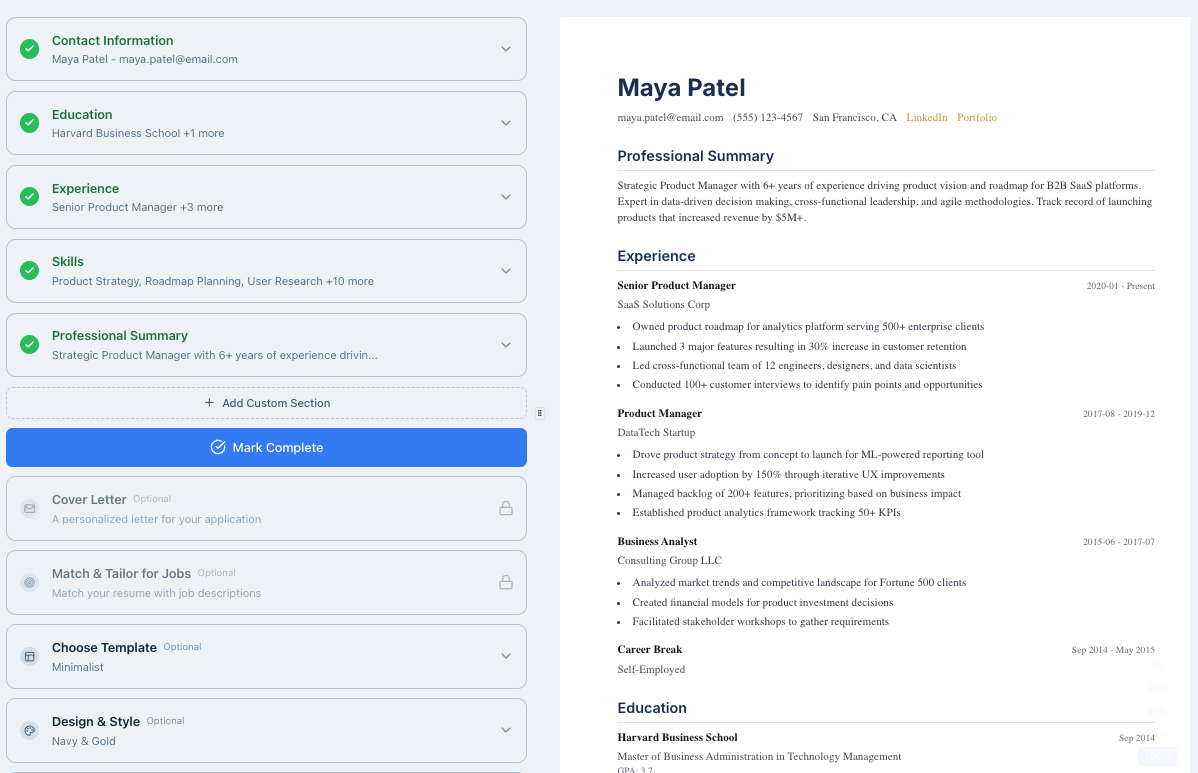
JobVouch already rewrites and optimizes your resume. Use that same language on LinkedIn. Your headline should reflect your target role. Your About section should echo your resume summary. Your experience bullets should match (or closely align with) your resume bullets.
Consistency signals professionalism. Inconsistency signals sloppiness.
The LinkedIn headline formula
Your headline is prime real estate. It shows up in search results, connection requests, and when recruiters hover over your name. Do not waste it on your current job title alone.
Formula: Role + Specialty + Proof
| Part | What it does | Example |
|---|---|---|
| Role | What you do or want to do | Product Manager |
| Specialty | Your niche or focus | B2B SaaS |
| Proof | A result or credibility signal | 3 products launched, 2M+ users |
Headline examples by role
| Role | Weak headline | Strong headline |
|---|---|---|
| Marketing | Marketing Manager | Growth Marketing Manager - Drove $2M pipeline through content and paid acquisition |
| Engineering | Software Engineer | Backend Engineer (Python, AWS) - Building scalable systems for fintech |
| Sales | Sales Representative | Enterprise AE - $1.5M closed in 2024, President's Club |
| Design | UX Designer | Product Designer - Designing B2B tools used by 50K+ daily users |
| Operations | Operations Manager | Operations Lead - Scaled fulfillment from 100 to 5K orders/day |
What to avoid in headlines
- "Open to opportunities" (desperate sounding and vague)
- Just your job title (missed opportunity)
- Buzzwords without context ("Thought leader," "Visionary")
- Emojis (unprofessional for most industries)
The About section template
Your About section is not your autobiography. It is a pitch. Recruiters skim it in seconds. Front-load the value.
Structure (5-7 lines max)
- Line 1: Who you are and what you do (role + specialty)
- Lines 2-3: Your biggest proof points (results, scale, recognition)
- Lines 4-5: What you are looking for (optional, but useful if actively searching)
- Line 6-7: Keywords naturally embedded
Example About section
Product manager with 6 years of experience building B2B SaaS tools for the healthcare and fintech industries.
At Acme Corp, I led the launch of three products that now serve 2M+ users. Increased user retention by 40% through data-driven feature prioritization and cross-functional collaboration with engineering and design teams.
I specialize in taking products from 0-1, building roadmaps, running user research, and aligning stakeholders around outcomes over outputs.
Looking for senior PM roles at mission-driven companies working on hard problems.
What to avoid in About sections
- Starting with "I am a passionate..." (cliche)
- Writing in third person ("John is a dedicated professional...")
- Long paragraphs with no line breaks
- Generic soft skills without proof ("Great communicator")
Aligning your Experience section
Your LinkedIn Experience section should match your resume in three critical areas:
1. Job titles
Use the same titles. If your resume says "Senior Product Manager" and LinkedIn says "PM II," recruiters may wonder if you are hiding something.
2. Dates
Use the same date ranges. Discrepancies get noticed during background checks.
3. Key achievements
You do not need identical bullets, but the major wins should appear in both places. If your resume highlights a $2M revenue achievement, it should show up on LinkedIn too.
How to handle different lengths
LinkedIn allows longer descriptions than a resume. Use that space wisely:
| Resume | |
|---|---|
| 3-4 bullets per job | 4-6 bullets per job |
| Tightest, most tailored language | Slightly more context and detail |
| Tailored to specific job | Optimized for broader search |
The complete LinkedIn optimization checklist
Profile basics
- Professional headshot (face visible, good lighting, simple background)
- Custom URL (linkedin.com/in/yourname)
- Banner image (optional but adds polish)
- Location set correctly
Headline and About
- Headline uses Role + Specialty + Proof formula
- About section leads with value, not biography
- Keywords from target roles are naturally embedded
- No buzzwords without evidence
Experience
- Titles match your resume
- Dates match your resume
- Top achievements from resume appear here
- Company descriptions added (especially for lesser-known companies)
Skills and endorsements
- Top 3 skills pinned are your most relevant
- 20+ skills added that match your target roles
- Endorsements requested from colleagues for key skills
Additional sections
- Education complete with graduation year
- Certifications added (if relevant)
- Featured section with portfolio link, article, or project
- Recommendations (aim for 2-3)
What NOT to do
- Do not leave your LinkedIn empty and expect recruiters to rely on your resume alone. They will check.
- Do not have different job titles or dates than your resume. This creates trust issues.
- Do not write in third person. It sounds like someone else wrote it for you.
- Do not stuff keywords awkwardly. "SEO expert, SEO specialist, SEO consultant, SEO manager" as your headline is spam.
- Do not post controversial content if you are job searching. Your activity is visible.
FAQ
Q: Should my LinkedIn and resume be identical? A: Not word-for-word, but they should be consistent. Same job titles, same date ranges, same major achievements. LinkedIn can be slightly more detailed since space is not as limited.
Q: Do recruiters actually check LinkedIn? A: Yes. Studies show 87% of recruiters use LinkedIn to vet candidates. If your profile is empty or contradicts your resume, it is a red flag.
Q: Should I connect with recruiters even if I am not job searching? A: Yes. Building relationships before you need them makes the job search easier later. Accept recruiter connection requests and engage occasionally with industry content.
Q: What if I am employed and do not want my boss to know I am looking? A: Use LinkedIn's "Open to Work" feature set to recruiters only. Update your profile gradually over time so it does not look like a sudden job search.
Q: How often should I update my LinkedIn? A: Update it whenever you update your resume. Also update it when you complete a major project or get a new certification, even if you are not actively searching.
Related Tools
- Free ATS Resume Checker — See how your resume scores before mirroring it on LinkedIn
- AI Resume Tailor — Optimize your resume language, then use the same phrasing on your LinkedIn profile
Related posts
- Stop Sending Generic Resumes: How to Tailor in 5 Minutes
- The "Cheat Codes" of Hiring: 50 Keywords Every Resume Needs
- The 2026 Resume Checklist: 10 Things to Check Before You Hit Submit
Make your LinkedIn work as hard as your resume
Your resume gets you considered. Your LinkedIn gets you found. Check your ATS score free, then use JobVouch to build optimized resume language you can mirror on LinkedIn for a consistent, professional presence.